





AMR Robots: Key Points
- Equipped with cameras and sensors, AMR robots identify obstacles and react by adjusting their speed or rerouting to avoid collisions
- AMRs usually fall into three main categories based on their role in warehouse operations: transport and sortation, picking, and inventory management
- AMRs don’t require extensive setup or programming, allowing for quick, seamless integration into existing warehouse workflows
The warehouse automation market’s rapid growth that reached $26.5 billion in 2024 signals a shift warehouse managers can’t ignore.
As labour shortages persist and customer demands rise, investing in technologies like autonomous mobile robots (AMRs), is becoming essential to stay competitive.
AMRs offer the flexibility, scalability, and intelligence needed to future-proof warehouse operations.
In this article, we will:
- Compare AMRs with traditional warehouse robots like AGVs
- Break down the different types of AMR robots and their core functions in warehouse operations
- Introduce Modula APAC solutions that can seamlessly integrate with AMRs and other automated warehouse robots
- Address common questions about AMRs
Understanding Autonomous Mobile Robots (AMRs)
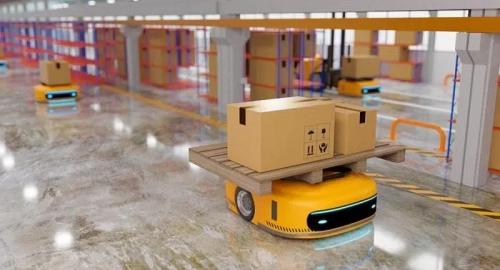
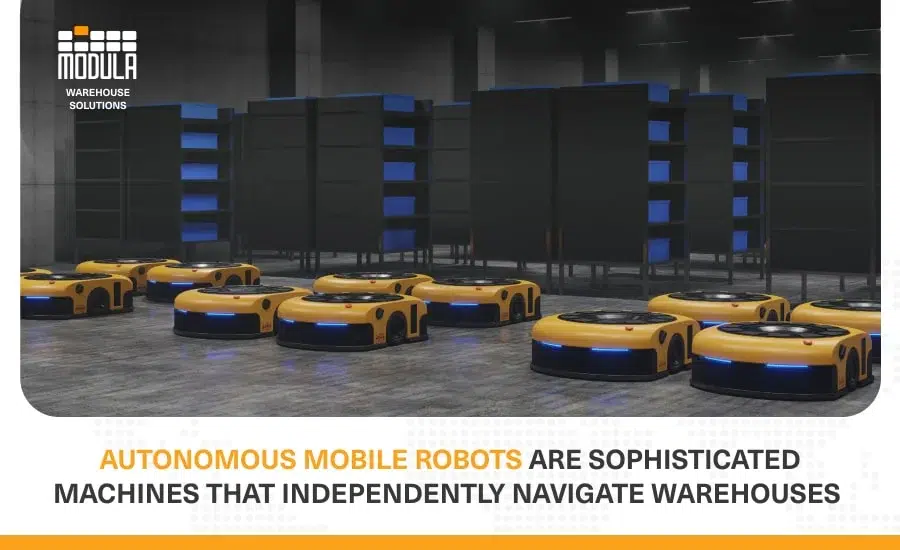
Autonomous mobile robots (AMRs) are sophisticated warehouse robots designed to navigate facilities and perform tasks without human intervention.
This autonomy allows AMRs to:
- Optimise task execution by identifying and following the most efficient routes
- Detect and avoid stationary obstacles such as shelving units, machinery, and workstations
- Navigate safely around dynamic hazards like warehouse staff, other robots, and forklifts
- Common Types of Autonomous Mobile Robots (AMRs)
AMRs are typically grouped into three categories based on their role in warehouse operations, including:
1. Transport and Sortation AMRs
These AMRs automate the movement, sorting, and handling of materials, allowing employees to stay at their workstations and focus on higher-value tasks.
Compared to traditional systems like tilt-tray or cross-belt conveyors, AMR-based sortation is more space-efficient and flexible. When equipped with robotic arms, these robots can independently load, unload, and deliver materials.
Since these warehouse robots operate independently, your employees can easily scale operations by adding more AMRs to handle demand surges.
2. AMRs for the Picking Process
AMRs enhance picking accuracy and efficiency by minimising travel time and enabling workers to focus on order fulfilment rather than navigating the warehouse.
- Area picking: Operators stay within assigned zones while AMRs, guided by onboard order interfaces, move between areas. When an AMR arrives, the operator places items into its tote. The robot then continues to the next zone or to packing, with multiple AMRs working in parallel to keep workflows moving.
- Goods-to-person (G2P) picking: In G2P setups, AMRs retrieve items from storage and deliver them to stationary pickers. The robot identifies the item, calculates the fastest route, and delivers it to the operator, who simply places it into the order tote.
3. AMRs for Inventory Management
Accurate, up-to-date inventory is key to running an efficient warehouse, and AMRs help make that possible.
For instance, warehouses can optimise inventory tracking by combining AMRs with radio frequency identification (RFID). This technology uses wireless signals and unique serial numbers to identify items, removing the need for manual scanning and accelerating inventory checks.
When integrated with a warehouse management system (WMS), AMRs provide continuous visibility, reduce human error, and boost productivity by freeing staff from time-consuming inventory tasks.
How Do AMR Robots Work?
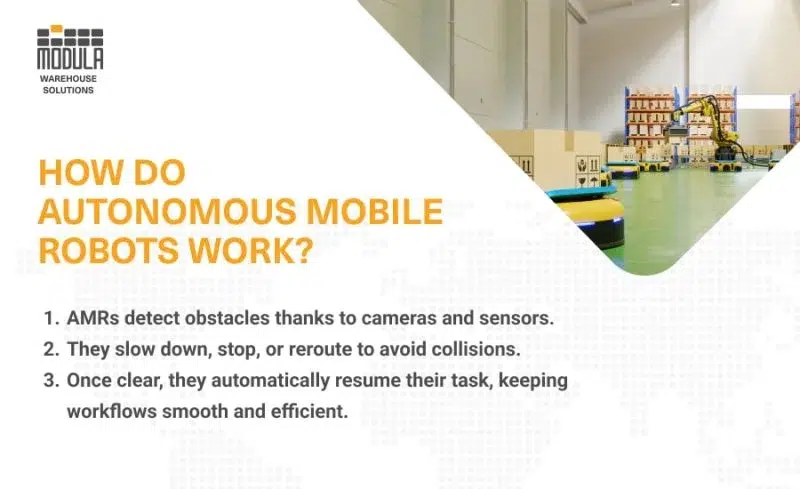
What makes AMRs stand out is their ability to handle the unexpected, whether it’s employees crossing their path or a blocked aisle.
With built-in cameras and sensors, they detect obstacles and respond by slowing down, stopping, or finding a new route.
Once the path is clear, they resume operations immediately, maintaining workflow continuity with minimal disruption.
AGV Robots vs. AMR Robots
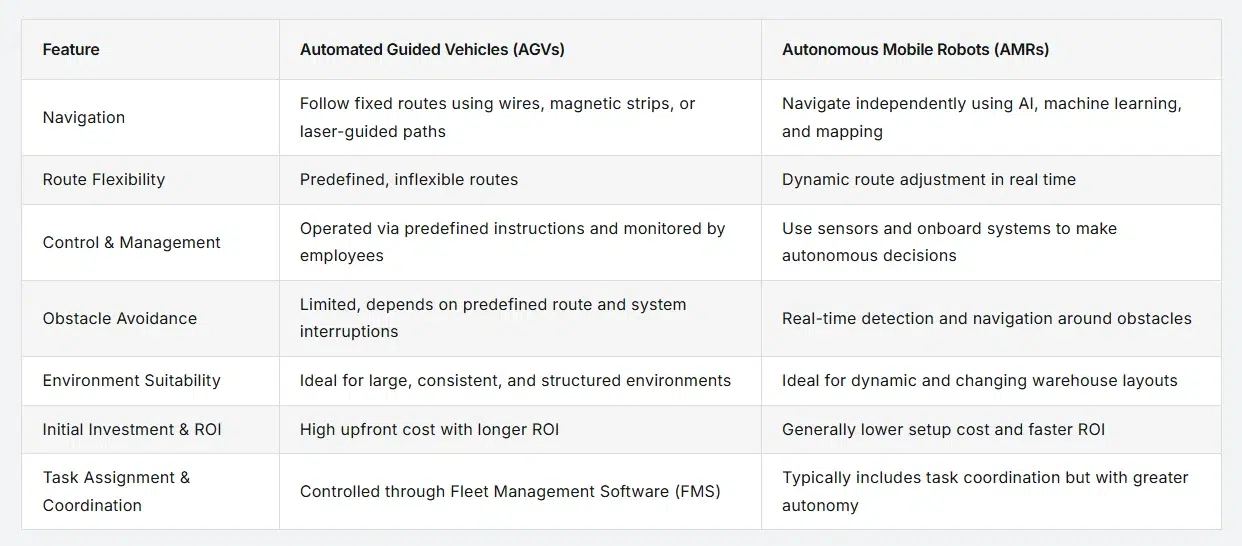
Automated guided vehicles (AGVs) are warehouse robots that follow fixed routes using markers like wires, magnetic strips, or laser-guided paths.
Warehouse employees manage AGVs by setting predefined routes and monitoring their system performance.
AGVs are effective in large facilities with consistent, repetitive tasks, where the high upfront investment and longer return on investment (ROI) can be justified.
Autonomous mobile robots (AMRs), on the other hand, navigate warehouses independently using AI, machine learning, and real-time mapping.
Equipped with cameras and sensors, they adjust routes in real-time to avoid obstacles like cluttered aisles or moving workers.
In contrast, AGVs follow operator-defined instructions for where to go, what to pick up, and where to deliver. Fleet management software (FMS) coordinates this process, assigning tasks and dispatching the most efficient robot for each job.
Key Considerations When Implementing AMR Robots in Your Facility
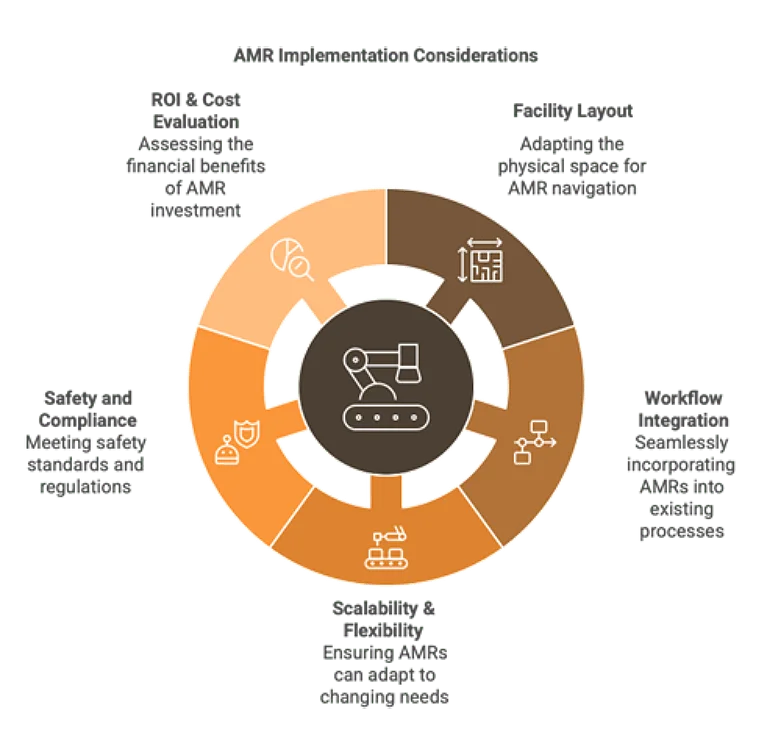
Autonomous mobile robots (AMRs) offer various benefits, but successful implementation requires thoughtful planning.
Consider the following:
1. Facility Layout & Infrastructure
Before deploying AMRs, evaluate your current facility setup:
- Are pathways clear enough for smooth robot movement?
- Is there reliable Wi-Fi or network coverage throughout your facility?
- Do you have charging stations and defined pick-up or drop-off points?
- Keep in mind that traditional warehouses might need upgrades to accommodate automation effectively.
2. Workflow Integration
Your AMRs should fit seamlessly into your existing processes. Ask yourself:
- Which tasks will they automate. Is it transporting, picking or restocking?
- How will they interact with your team, equipment, and systems?
- Can they connect with your WMS or ERP software?
A clear integration plan keeps operations running smoothly from day one.
3. Scalability & Flexibility
Choose AMRs that grow with your operations:
- Can they scale as your order volume increases?
- Are they adaptable to future layout changes or new workflows?
- Do they support easy updates without needing a full system overhaul?
4. Safety and Compliance
AMRs operate alongside humans in fast-paced, often unpredictable environments, making safety a top priority.
To ensure a secure deployment:
- Equip AMRs with safety tech like LiDAR, 3D cameras, ultrasonic sensors, and emergency stop functions for real-time obstacle detection
- Train staff on safe AMR interaction, emergency protocols, and alert response to minimise risk
- Ensure compliance with safety standards like ISO 3691-4, along with other local labour regulations
5. ROI & Cost Evaluation
Understand the full investment of AMRs:
- Initial hardware and software costs
- Ongoing maintenance and support
- Training and onboarding expenses
Then weigh these against the long-term benefits: lower labour osts, faster workflows, and fewer errors. Most businesses achieve ROI within one to two years when they deploy AMRs effectively.
Discover Automated Warehouse Robots at Modula APAC
Integrating autonomous mobile robots with Modula’s automated solutions delivers a powerful boost to order fulfilment efficiency.
Whether you’re managing a compact facility or a large-scale operation, our technologies are engineered to enhance picking accuracy, optimise workflows, and improve workplace safety.
Modula’s solutions, including the Modula Lift and Modula Flexibox, are designed to seamlessly integrate with AMRs.
This integration allows AMRs to autonomously transport goods between different areas of the warehouse and the Modula storage systems, facilitating a fully automated material handling process.
Beyond AMRs, they integrate seamlessly with AGVs, cobots, and robotic picking stations, enabling fully customised, end-to-end warehouse automation.
AMR Robot: FAQs
1. What are the common applications of AMRs?
AMRs are widely used in industries such as manufacturing, warehousing, healthcare, and logistics.
Typical applications include:
- Transporting goods within warehouses or factories
- Assisting in eCommerce fulfilment centres
- Supporting inventory management through scanning and data collection
2. What are the benefits of using AMRs over traditional automation methods?
AMRs offer several advantages over traditional automation, including:
- Flexibility: Easily reprogrammed or re-routed without changes to physical infrastructure
- Scalability: New units can be added without major disruptions
- Efficiency: Operate 24/7 with minimal supervision
Safety: Designed to work around people with advanced obstacle detection and safety protocols
3. Do AMRs require extensive setup or programming?
No. A major advantage of AMRs is their fast, hassle-free deployment.
Most AMRs feature user-friendly software that lets you define routes, tasks, and zones, no coding required.
They also adapt quickly to layout or workflow changes, making them a smart choice for fast-moving industries where flexibility is key.
For example, if a warehouse adds a new storage zone or reconfigures aisles to accommodate seasonal inventory, AMRs can quickly update their internal maps and reroute accordingly.
![Automated warehouse picking system [Advantages + Challenges]](https://en.modula.cn/wp-content/uploads/2026/04/Modula-Picking-Solutions2-800x450-1-500x270-c-center.webp "Automated warehouse picking system [Advantages + Challenges]")