






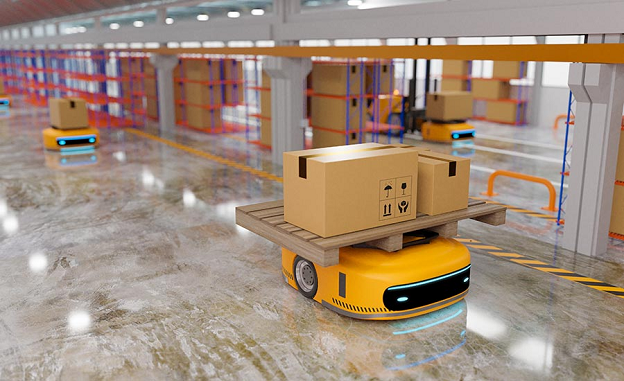
Automated guided vehicles (AGVs) are driverless devices used to transport goods in warehouses and factories.
For warehouse operations facing labor shortages or space constraints, AGVs can help optimize workflow, reduce manual labor, and improve overall efficiency.
In addition, AGVs can travel through narrow aisles, operate around the clock, and handle repetitive tasks, freeing employees to focus on more complex tasks such as quality inspection.
In this guide, we’ll give you a comprehensive introduction to automated guided vehicles (AGVs), including their types, benefits, and Modula APAC’s vertical lift modules (VLMs) that integrate seamlessly with AMRs to help increase warehouse productivity.
What are automated guided vehicles (AGVs)?
An automated guided vehicle is a battery-powered robot used to transport goods in warehouses.
It is regarded as the predecessor of autonomous mobile robots (AMR) and is guided and navigated through visual cameras, radio waves, magnetism or lasers.
Automated Guided Vehicles (AGVs) vs. Autonomous Mobile Robots (AMRs)
Automated guided vehicles (AGVs) follow fixed routes set by markers such as cables, tape or laser paths.
Warehouse operators typically do not need to manually operate AGVs, but instead set routes, monitor systems and manage workflow to ensure the vehicles are running efficiently.
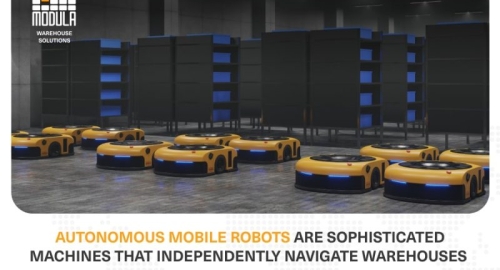
Autonomous mobile robots (AMRs), on the other hand, can navigate autonomously in warehouses through artificial intelligence, machine learning and dynamically generated maps.
Equipped with cameras and proximity sensors, AMRs can calculate driving paths in real time to cope with changing environments or obstacles such as channel congestion.
Warehouse operators can direct AGVs to go to designated locations, pick up specific goods and deliver them to their destination.
Fleet management software (FMS) is crucial in this process. This central control system evaluates material requests (such as new orders) and decides which vehicle to send to handle each shipment.
Types of Automated Guided Vehicles (AGVs)
There are many types of AGVs on the market, including:
1. Automated Guided Carts
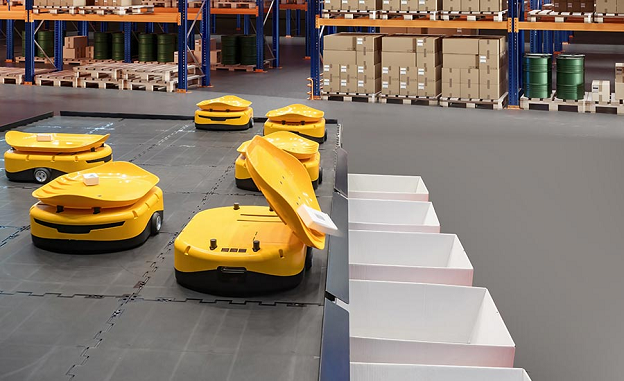
AGC is the most basic form of AGV and is commonly used for tasks such as sorting, storage and cross-docking.
It can transport a variety of materials, from small parts to entire pallets.
2. Towing AGVs (Towing AGVs)
A tractor-trailer, also known as a tractor-trailer AGV, can tow multiple unpowered, cargo-carrying carriages like a train.
Such vehicles, often called driverless trains, rely on wheels and are suitable for transporting heavy goods over long distances.
3. Forklift AGVs
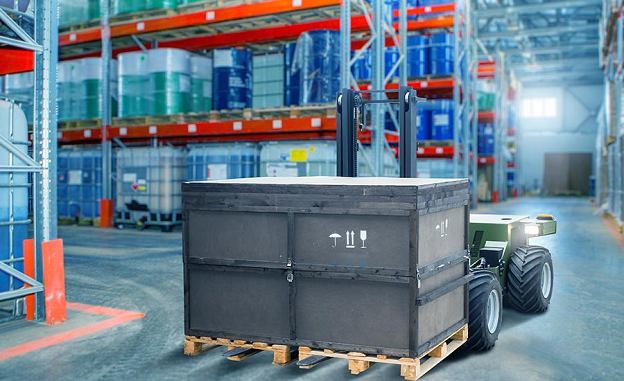
Forklift-style automated guided vehicles, or forklifts, can perform the same tasks as manual forklifts, such as pallet handling.
But unlike traditional forklifts, it requires no manual operation.
4. Unit Load Handlers
This type of vehicle is used to move single items of goods, such as pallets or boxes of materials, between two designated points.
It can be used for handling and distribution in all aspects of the production process, such as receiving, storing and shipping.
5. Heavy Burden Carriers
Heavy Duty Trucks transport the heaviest cargo such as castings, large coils or steel plates.
Some models have a self-loading function and can support a variety of steering methods, including standard steering, pivot steering or omnidirectional steering.
How do automated guided vehicles (AGVs) work?
AGVs operate in industrial environments and rely on advanced navigation systems to move materials. Navigation methods can range from simple tape navigation to complex laser or camera navigation systems.
- The AGV uses magnetic sensors to identify tracks formed by tape laid on the ground or embedded cables. These cables emit signals that the AGV receives via sensors or antennas and travels along them.
- The AGV moves forward or backward by keeping the wheels on both sides at the same speed.
- AGVs use sensors and cameras to detect obstacles, adjust their driving paths to avoid collisions, and ensure safe operation. Wireless transmitters are set up in some areas, and the AGV’s sensors will return a response after receiving the signal.
- If the path is clear, the AGV receives a “clearance” signal and is allowed to proceed. AGVs equipped with “collision avoidance area control” will also actively send signals and wait for responses to determine whether there are obstacles ahead.
- The AGV’s software system is responsible for coordinating tasks and paths and integrating with the warehouse’s management system to receive task instructions and update task status.
- The AGV communicates with the central control system through Wi-Fi or other wireless networks, receives navigation instructions and feedbacks execution status.
Integrate AGV with vertical lifting module to speed up your operational efficiency
Integrating AGVs with our automation solutions significantly improves order fulfillment efficiency.
No matter the size of your operation, our systems optimize picking accuracy, increase productivity and keep workers safe.
One popular solution offered by Modula APAC is our Vertical Lift Module (VLM). This is a fully automatic, compact vertical storage system that maximizes warehouse space savings by storing materials vertically.
A surge in orders? Our VLM supports batch orders and multiple order processing models to increase production capacity without interrupting the order fulfillment process.
These vertical systems ensure that vast inventories are both securely stored and quickly accessible, automatically delivering items to operators simply by scanning a barcode or tapping the intuitive Copilot controller.
You can also integrate your existing warehouse system with our picking and warehouse management system (WMS) to further improve accuracy, efficiency and overall output. Our picking solutions are easy to deploy and speed up the entire process.

Automated guided vehicles (AGVs) are driverless machines that transport goods in warehouses and factories.
For warehouse operations facing labour shortages or limited space, AGVs can help optimise workflows, minimise manual labor, and boost overall efficiency.
Additionally, they can navigate narrow aisles, operate around the clock, and manage repetitive tasks, allowing your staff to tackle more complex duties, such as performing quality checks.
In this guide, we’ll share everything you need to know about automated guided vehicles (AGVs), including the types, their benefits, and Modula APAC’s vertical lift modules (VLMs) that seamlessly integrate with AMRs to boost productivity in your warehouse operations.
What Are Automated Guided Vehicles (AGVs)?
Automated guided vehicles are battery-powered robots that transport goods in a warehouse space.
They are considered the predecessors of autonomous mobile robots (AMRs) and use vision cameras, radio waves, magnets, and lasers to navigate a facility.
Automated Guided Vehicles (AGVs) vs. Autonomous Mobile Robots (AMRs)
Automated guided vehicles (AGVs) follow fixed routes guided by markers such as wires, magnetic strips, and laser paths.
Warehouse operators typically don’t need to manually operate AGVs. Instead, they set up routes, monitor systems, and manage workflows to ensure these vehicles operate effectively.
In contrast, autonomous mobile robots (AMRs) navigate the warehouse independently using artificial intelligence, machine learning, and dynamically generated maps.
Equipped with cameras and proximity sensors, AMRs calculate routes in real time so they can adjust to changing conditions and obstacles, such as cluttered pathways.
A warehouse operator can direct an AGV on where to go, what goods to pick up, and where to drop them off.
Leveraging fleet management software (FMS) is essential during this process, as central control systems assess requests for goods, such as incoming orders, and decide which vehicle to send for each load.
Types of Automated Guided Vehicles (AGVs)
Different types of automated guided vehicles are available on the market, including:
1. Automated Guided Carts
Automated guided carts (AGCs) are the simplest form of AGVs and are commonly used in sorting, storage, and cross-docking tasks.
AGCs can transport a wide range of materials, from small parts to full pallets.
2. Towing AGVs
Towing vehicles, also known as tugger automated guided vehicles, can haul multiple unpowered, cargo-bearing vehicles in a train-like sequence.
Often called driverless trains, these vehicles move on wheels and are typically used to transport heavy loads over long distances.
3. Forklift AGVs
Forklift automated guided vehicles, or fork vehicles, perform the same functions as human-operated forklifts, such as transporting pallets.
However, unlike a conventional forklift, they don’t require a human operator to function.
4. Unit Load Handlers
Unit load handlers are vehicles that transport individual items, such as pallets or totes, from point A to point B.
These machines facilitate in-process handling and distribution tasks, such as receiving, storing, and shipping.
5. Heavy Burden Carriers
Heavy burden carriers can transport the heaviest loads, such as castings, heavy coils, or plates.
These carriers may feature self-loading functions and offer various steering options, including standard, pivot, or omnidirectional.

How Do Automated Guided Vehicles (AGVs) Work?
Automated guided vehicles operate within industrial settings, utilising advanced navigation systems to move materials. Their navigation methods range from simple magnetic tapes to complex laser-guided or camera-based systems.
- Automated guided vehicles navigate facilities using systems like magnetic sensors, following tracks made of magnetic tape or wires embedded in the floor. These wires transmit signals that automated guided vehicles detect through sensors or antennas.
- For automated guided vehicles to move forward or backward, their wheels move at the same speed.
- Automated guided vehicles detect obstacles, adjust their routes to avoid collisions, and maintain safe operations using sensors and cameras. A wireless emitter dispatches signals in designated areas, and the AGV’s sensor picks up and echoes these signals.
- If the path is unobstructed, a “clear” signal permits the AGV to proceed. Vehicles equipped with “collision avoidance zone control” also emit a signal and wait for a response to detect any objects ahead.
- AGV software manages automated guided vehicles by coordinating tasks and routes, integrating with the facility’s management systems to receive and update task statuses.
- Automated guided vehicles communicate with a central control system via Wi-Fi or other wireless networks to receive directions and provide updates.
Speed Up Your Operations by Integrating AGVs With Vertical Lift Modules
Integrating AGVs with our automated solutions significantly enhances the order fulfillment process.
No matter the size of your operations, our systems optimise picking precision, workflow productivity, and employee safety.
One popular solution at Modula APAC is our VLMs. Our Vertical Lift Modules (VLMs) are fully automated, compact vertical storage systems that maximise space by vertically organising items and significantly reducing the warehouse footprint.
Facing an uptick in orders? Our VLMs support both batch and multi-order modes, boosting productivity without disrupting the order fulfillment flow.
These vertical systems ensure a vast inventory is readily accessible and securely stored, delivering items automatically to operators with a simple barcode scan or a tap on the intuitive Copilot controller.
You can also boost accuracy, efficiency, and overall productivity by combining your existing warehouse solutions with our picking and warehouse management system (WMS). Easy to implement, our picking solutions elevate accuracy and efficiently expedite throughput.

2. How often do you need to access items?
VLMs are the way to go if your operations require frequent access to a diverse range of items.
For example, if you run a distribution centre that handles a range of products—from electronics to clothing—a VLM can help your warehouse operators quickly and efficiently retrieve items during order picking.
3. What operational speed do you need?
In environments where time is crucial and rapid retrieval impacts workflow, consider vertical lift modules.
They operate at high speeds and allow access to multiple items from different shelves simultaneously.
This is especially beneficial in settings like automotive assembly lines or pharmaceutical distribution, where saving time on item retrieval can significantly boost efficiency.
4. What is your budget?
If you have a larger budget and seek a long-term, efficient, and adaptable solution, investing in a VLM is an excellent choice.
For instance, a manufacturing facility that stores high-value items can use the VLM’s advanced features and flexibility to prevent theft.
Find Cutting-Edge Vertical Lift Modules (VLMs) at Modula APAC
At Modula APAC, we provide automated vertical lift modules that expand your warehouse space by efficiently utilising your available ceiling height.
Our systems ensure your warehouse staff can easily access inventory, all while keeping goods stored in a safe and secure environment.
If you want to upgrade your storage space and improve operational efficiency, we offer a range of vertical lift modules, including:
- Modula Lift: Our most popular vertical lift module, Modula Lift, comes in a variety of sizes and capacities, helping businesses streamline and modernise their operations.
- Modula Slim: Modula Slim incorporates the same innovative storage technology as the Lift model, delivering equivalent advantages — greater efficiency and increased picking precision — in a more space-saving design. It’s perfect for storing individual materials and smaller items, such as boxes, bins, spare components, coils, bottles, and more.
- Modula Next: Modula NEXT, our next generation lift module, is equipped with advanced safety controls for automated warehouse picking. Its expertly designed bay opens only to the designated compartment, eliminating picking errors and item loss.
Reach out to our team to understand how our innovative vertical lift modules can streamline your warehouse operations.
![Automated warehouse picking system [Advantages + Challenges]](https://en.modula.cn/wp-content/uploads/2026/04/Modula-Picking-Solutions2-800x450-1-500x270-c-center.webp "Automated warehouse picking system [Advantages + Challenges]")