







Overview of key takeaways
- An investment in warehouse robots typically pays off within 3 to 5 years.
- Deploy a warehouse management system (WMS) and see benefits within 3 to 6 months.
- To calculate ROI, subtract costs from benefits, divide by costs, and multiply by 100 to get a percentage.

Warehouse robots have helped many companies increase production efficiency by 30%, making them a popular choice when looking to improve efficiency and reduce operating costs.
So, when will there be tangible financial benefits?
The ROI time for warehouse robots versus WMS varies – typically 3 to 5 years for robots and 3 to 6 months for WMS.
In order to measure their effectiveness, the key is to correctly calculate ROI.
This guide will:
- Overview of the ROI of Warehouse Robots vs. WMS
- Provide detailed ROI calculation steps
- Explain how Modula China Pacific solutions can help you maximize your return on investment
Warehouse Robot ROI Analysis
Generally speaking, a warehouse robot investment can pay for itself within 3 to 5 years.
Deciding whether to invest in robots involves many factors, including industry competitiveness and market share.
Although these factors are not as easy to quantify as financial indicators, they are equally critical in the decision-making process.
How to calculate the ROI of warehouse robots?
Return on investment (ROI) is an important metric that evaluates the relationship between annual earnings and investment costs.
The higher the ROI, the greater the return and the stronger the investment attractiveness.
To calculate the ROI of a warehouse robot investment, consider its costs and benefits.
We’ll take the following steps to help you gain clarity on how to develop a warehouse automation strategy.
Step one: identify costs
Determine the total investment required to deploy a robotic system, including:
- Initial costs: procurement, installation and system integration fees
- Operating costs: maintenance, repairs, software updates and energy consumption
- Training costs: related training costs for employees to operate and maintain the system
- For example: Purchase 5 robots at $50,000 each, with installation costs of $20,000 and annual maintenance and training costs of $10,000. The total initial investment is $270,000.
Step 2: Calculate income
Quantify the financial benefits of robotic systems, such as:
- Save labor costs: reduce the number of employees due to automation
- Increase productivity: increase output or speed up inventory management
- Reduce error rates: Reduce returns or rework costs caused by errors
For example: The robot saves $100,000 in labor costs every year, increases profits by $50,000 by increasing throughput, and reduces error-related costs by $20,000, for a total annual benefit of $170,000.
Step 3: Calculate ROI
The formula is as follows: ROI = [(Revenue – Cost) ÷ Cost] × 100
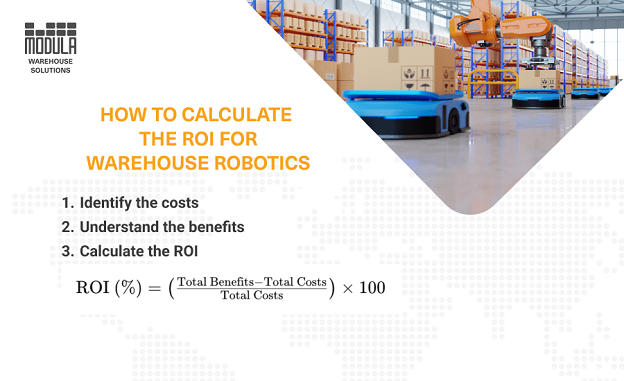
Calculation example:
- First year cost: $270,000
- First year earnings: $170,000
- Net income: $170,000 – $270,000 = -$100,000 (negative return in the first year)
How warehouse robots accelerate ROI?
Warehouse robots can accelerate ROI by increasing efficiency and reducing expenses by:
1. Reduce labor costs
Robots can automatically perform picking, packaging, sorting and other tasks, significantly reducing manpower requirements.
For example, an autonomous mobile robot (AMR) can work around the clock on multiple shifts, potentially cutting labor costs in half.
For example: If the warehouse spends $500,000 per year on related operations, introducing AMR can save $250,000.
2. Improve production efficiency and throughput
The robot’s operation speed is fast and takes a long time, which can significantly improve the efficiency of order processing.
For example, a goods-to-person (G2P) system can triple picking speeds, generating an additional $300,000 in annual revenue.
3. Reduce operating errors
Robotic systems can control errors more effectively than humans and reduce losses caused by returns, rework and inaccuracies.
For example: If picking errors cost $100,000 per year, a robotic scanning system can reduce the error rate by 90%, saving $90,000 per year.
4. Optimize warehouse space utilization
Automated storage and retrieval systems (ASRS) can increase storage density by up to 25%, delaying or avoiding the need for expansion and saving space and operating expenses.
The two types of warehouse robots with the highest return on investment
Various warehouse robot types can help you maximize cost savings in the long run.
The following two types of robots typically achieve the highest ROI:
Autonomous Mobile Robot (AMR)
AMR is ideal for companies that want to gradually introduce automation and reduce the risk of initial investment.
It can handle pallets and inventory autonomously, reducing labor expenses and improving operating efficiency.
AMR frees up staff resources to focus on more important tasks, such as quality inspection.
Goods-to-Person (G2P) robot
By having robots deliver items to pickers, the system significantly reduces time spent moving around.
At the same time, SKUs can be stored more compactly, improving order accuracy and further reducing costs.
WMS ROI Timeline
Warehouse management systems typically provide a return on investment within 3 to 6 months.
As operational processes continue to be optimized, additional benefits will be realized within 3 to 12 months.
How to calculate ROI for WMS?
Step-by-step guide:
Step 1: Confirm the cost
The first step in calculating WMS ROI is to evaluate implementation costs.
Deployment costs for a WMS typically include:
- Software license fee
- Implementation costs (software installation, configuration and necessary hardware)
- Employee training costs
- Maintenance and technical support costs
Step Two: Identify Benefits
Typical benefits of deploying a WMS include:
- Improve work efficiency (such as inventory tracking and order processing)
- Reduce error rates and waste
- Improved data accuracy helps make accurate decisions
- Optimize customer service experience and shorten delivery cycle
Step 3: Calculate ROI
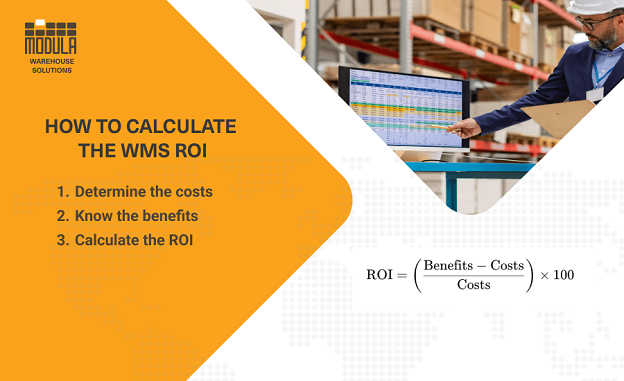
The formula is also: ROI = [(Benefit – Cost) ÷ Cost] × 100
Calculation example: If the WMS implementation cost is $100,000, the cumulative benefit over three years is $400,000:
ROI = [($400,000 – $100,000) / $100,000] x 100
ROI = [($300,000) / $100,000] x 100
ROI = 300%
This calculation shows that for every dollar invested in your WMS, you can earn three dollars in return over three years, highlighting the huge return on investment.
Industries suitable for investment in robots and WMS
Industries with high throughput and high requirements for speed and accuracy are most suitable for introducing warehouse automation technology, such as:
E-commerce and retail
The rapid development of e-commerce requires more efficient order fulfillment and inventory control.
For example, Amazon uses robotics and advanced warehouse management systems to sort packages and manage inventory, significantly reducing delivery times.
manufacturing
Robots can autonomously move materials and components, while WMS improves inventory and process control.
Pharmaceutical industry
Robots can sort medicines and packaging, ensuring accuracy and reducing the risk of contamination.
WMS improves sorting efficiency, tracking capabilities and delivery speed.
Food & Beverage
Automated systems help control quality, manage perishable goods and optimize assembly and shipping processes.
In dairy plants, robots and WMS streamline operations from bottling to packaging, enhance product handling capabilities, and ensure optimal storage conditions.
Automotive industry
Robots are capable of high-precision work such as welding, spray painting and small parts assembly.
WMS ensures that critical components are available in a timely manner.
Third Party Logistics (3PL)
3PL companies use robots and WMS to improve picking efficiency and accuracy.
Speed up order fulfillment and serve global customers.
Maximize return on investment with automation
At Modula China Pacific, we revolutionize warehouse operations by maximizing space utilization, improving precision and productivity, and enhancing operational safety.
Modula Vertical Lift Module (VLM)
We offer Modula Vertical Lift Modules (VLM) for high-rise warehousing.
Items can be easily delivered via the Copilot controller.
Items can be easily retrieved via the Copilot controller.
Equipped with optional accessories such as automatic doors and telescopic pallets to improve operating efficiency and accessibility.
Modula Warehouse Management System (WMS)
Modula provides a variety of advanced warehouse management software that supports remote monitoring and data analysis.
Easy to quickly integrate into existing platforms such as ERP, MRP, WMS, DMS, etc.
Whether it’s optimizing inventory processes, improving storage efficiency, or improving order accuracy, Modula’s ASRS and WMS solutions can help you achieve your business goals.

ROI for Warehouse Robotics and WMS [Timeline & Formula]
ROI for Warehouse Robotics and Warehouse Management System: Key Points
- You should see a return on investment in warehouse robotics within three to five years
- You might notice a return on investment from a warehouse management system (WMS) within three to six months
- To calculate the ROI of warehouse robotics, subtract the costs from the benefits, divide by the costs, and multiply by 100 to get the percentage

Warehouse robots have increased productivity by 30% across various businesses, making them a popular choice when you’re looking to enhance efficiency and minimise operational costs.
So when do they start delivering tangible financial benefits?
ROI for warehouse robotics and warehouse management systems can vary, usually spanning three to five years for robots and three to six months for WMS.
To gauge effectiveness, you need to calculate ROI.
In this guide, we will:
- Outline the ROI for warehouse robotics and WMS
- Share a step-by-step guide on how to calculate their ROI
- Explain how Modula APAC solutions can help maximise your returns
ROI for Warehouse Robotics
You can expect to see a return on your investment in warehouse robotics within three to five years.
Deciding whether to invest in warehouse robotics involves multiple factors, such as industry competitiveness and market share.
How To Calculate the ROI for Your Warehouse Robotics
Return on investment (ROI) is a performance measure that calculates the ratio between annual benefits and investment costs.
A higher percentage indicates a greater return, making the investment more attractive.
You must assess both the costs and benefits of this technology to calculate the ROI for your warehouse robotics.
We’ll guide you through this calculation to help you make informed decisions about your warehouse automation strategy.
1. Identify the Costs
First, determine the total investment required for the robotics system, which includes:
- Initial costs: This includes purchase, installation, and integration costs.
- Operational costs: Maintenance, repairs, software updates, and energy use.
Training costs: Staff training for system operation and maintenance.
Example: If you purchase five robots at $50,000 each, with $20,000 for installation and $10,000 annually for maintenance and training, you will spend a total of $270,000 initially.
2. Calculate Benefits
Then, quantify the financial benefits your business will gain from the robotics system. These might include:
- Labor savings: Decrease in labor costs due to automation.
- Increased productivity: Enhancements in throughput or faster inventory management.
- Quality improvements: Fewer errors and associated costs.
Example: If warehouse robots allow you to save $100,000 annually in labor, generate an additional $50,000 in profits through increased throughput, and cut $20,000 in error-related costs, your annual benefits will total $170,000.
3. Calculate ROI
Calculate the ROI by subtracting the total costs from the total benefits, dividing the result by the total costs, and then multiplying by 100 to express it as a percentage:
While these aren’t as easily quantifiable as financial returns, they still play a key role in shaping the decision-making process.

Example calculation:
- Year 1 costs: $270,000 (initial investment + maintenance + training)
- Year 1 benefits: $170,000
- Net year benefits: $170,000 – $270,000 = -$100,000 (loss in the first year)
How Do Warehouse Robotics Deliver a Quick ROI?
Warehouse robotics can deliver a quick return on investment (ROI) by enhancing efficiency and reducing costs. Here’s how these systems contribute to achieving rapid ROI.
1. Reduce Labor Costs
Robotic systems drastically cut manual labor costs in tasks like picking, packing, and sorting.
For instance, an autonomous mobile robot (AMR) can operate non-stop across multiple shifts, potentially halving labor costs.
If a warehouse spends $500,000 annually on these tasks, implementing AMRs could save $250,000 each year.
2. Increase Productivity and Throughput
Robots operate faster and longer than humans, significantly boosting productivity and saving time.
For example, a G2P system can triple order picking speeds, directly enhancing ROI by enabling $300,000 in additional annual revenue from faster processing.
3. Minimise Errors
Robots decrease errors more effectively than humans to cut costs related to returns, rework, and inaccuracies.
To illustrate, robotic scanners can decrease picking errors by as much as 90%. If errors usually cost a warehouse $100,000 annually, this can save $90,000 each year.
4. Optimise Space
Robotics enhance warehouse space utilisation, increasing storage density by up to 25% with automated storage and retrieval systems (ASRS). This efficiency can postpone or negate the need for expansion, significantly saving on real estate and operational costs.
Top 2 Robots With the Highest ROI
Various warehouse robotic types can help maximise your savings in the long run.
Below, we highlight different warehouse robots that yield significant savings and higher ROI.
1. Autonomous Mobile Robots (AMR)
Ideal for companies new to robotics and cautious of large initial investments, autonomous mobile robots (AMRs) seamlessly integrate into existing operations.
AMRs automate pallet and inventory movement, cutting labor costs and boosting facility efficiency.
By operating independently, they allow employees to concentrate on more critical activities, such as performing quality checks.
2. Goods-to-Person Robots
Warehouse robots deliver inventory to stationary pickers in the goods-to-person approach, eliminating non-essential movement and significantly reducing labor.
This system also maximises space by compactly storing more SKUs, enhancing order accuracy, and driving further cost savings.
Warehouse Management System (WMS) ROI Timeline
You can typically expect to see an ROI from implementing a warehouse management system (WMS) within three to six months.
More significant improvements and ROI accrue over three to 12 months as processes are streamlined.
How To Calculate Your WMS ROI
Here’s a step-by-step guide:
1. Determine the Costs
The first step in calculating your WMS’s ROI is to assess the implementation costs.
These include:
- Software licensing fees: The cost to purchase or license the WMS software.
- Implementation costs: Expenses for installing and configuring the software and any necessary hardware or equipment.
- Training costs: Expenses for employee training can include initial sessions and ongoing support for proficiency.
- Maintenance costs: Ongoing expenses for maintenance and support, including software updates and technical support.
2. Acknowledge the Benefits
The next step is to recognise the benefits of using a WMS, which include:
- Increased productivity and efficiency: A WMS streamlines specific tasks such as inventory tracking and order processing.
- Reduced errors and waste: A WMS minimises errors and waste by automating inventory updates and offering real-time stock visibility, preventing overstocking and understocking.
- Improved accuracy: A WMS provides detailed inventory and order data, enabling precise decision-making and operational adjustments.
- Better customer service: A WMS streamlines order fulfillment, shortens delivery times, and ensures reliable tracking, boosting customer satisfaction.
3. Calculate Your WMS ROI
ROI = [(Benefits – Costs) / Costs] x 100
For example, if your WMS implementation costs $100,000 and provides $400,000 in benefits over three years, you would calculate the ROI as follows:
ROI = [($400,000 – $100,000) / $100,000] x 100
ROI = [($300,000) / $100,000] x 100
ROI = 300%
This calculation indicates that for every dollar invested in your WMS, you can expect to receive three dollars in return over a three-year period, highlighting a substantial return on investment.

Which Industries Should Invest in Warehouse Robotics and WMS?
Industries that benefit most from warehouse robotics and WMS typically involve high-volume operations or demand precise and rapid handling, such as:
1. ECommerce and Retail
The surge in online shopping requires faster order fulfillment and precise inventory management.
For example, Amazon employs robotics and advanced WMS to sort packages and manage inventories, drastically reducing delivery times.
2. Manufacturing
Robots automate material and component movement, streamlining supply chains, while WMS enhance inventory control and workflow efficiency.
3. Pharmaceuticals
Robots sort pills, package medications, and handle delicate materials in pharmaceutical facilities to ensure accuracy and reduce contamination risks.
On the other hand, warehouse management systems optimise storage layouts, improve inventory tracking, and boost distribution speed and efficiency in pharmaceutical facilities.
4. Food and Beverage
Automation ensures consistent quality control, manages perishable goods, and enhances packing and shipping operations.
In dairy factories, robots and WMS streamline operations from bottling to packaging, enhancing product handling and ensuring optimal storage conditions.
5. Automotive
In the automotive industry, warehouse robots excel in performing high-precision, repetitive tasks such as welding, painting, and assembling small parts, further decreasing errors.
These technologies also accelerate engine and chassis assembly, boosting production efficiency by ensuring components are available when needed.
6. Third-Party Logistics (3PL)
3PLs leverage robotics to enhance the accuracy and efficiency of picking and packing processes across various industries.
For example, logistics companies utilise robots and WMS to automate picking and packing, improve inventory accuracy, and expedite order fulfillment globally.
Maximise Your ROI With Warehouse Automation
At Modula APAC, we transform warehouse operations by maximising space utilisation, boosting precision and productivity, and enhancing safety, among other advantages.
Modula Vertical Lift Modules (VLMS)
Our offerings include the Modula Vertical Lift Modules (VLMs), ideal for warehouses with high ceilings.
These automated storage and retrieval systems efficiently manage large inventories and swiftly deliver items with just a click on the Copilot controller.
These intelligent storage systems efficiently house vast inventories and promptly fetch items with a mere click on the Copilot controller.
These VLMs come with optionals, such as automatic doors and telescopic bays to improve accessibility and speed up the retrieval process.
Modula Warehouse Management System (WMS)
Modula offers a variety of advanced warehouse management software solutions that provide remote support and analytics solutions to different organisations.
These software packages are easy to install and integrate seamlessly with our customers’ existing ERP, MRP, WMS, and DMS platforms.
Whether you’re aiming to refine your inventory processes, boost storage efficiency, or enhance order accuracy, Modula’s ASRS and WMS solutions can help meet your needs and propel your business to success.