






On June 25, the 2026 China Warehousing and Distribution Industry Development Report (Blue Book) was officially published.
The China Warehousing and Distribution Industry Development Report has been continuously released for 20 years. It is led by the China Warehousing and Distribution Association (CWDA) and co-authored by external experts and scholars.
Modena, as a leader in the intelligent vertical lift cabinet industry, participated for the first time in writing the section “2025 Smart Warehouse Cabinet Development and 2026 Outlook,” aiming to make a positive contribution to cultivating market demand and promoting technological development in the industry.
Let’s take a look at Modena’s review of the smart cabinet industry in 2025 and its outlook for 2026!
Note: This report is excerpted from Part I, “Industry Development Report,” of the latest 2026 China Warehousing and Distribution Industry Development Report (Blue Book) published by the China Warehousing and Distribution Association:
Overview of Smart Warehouse Cabinets
(I) Core Components
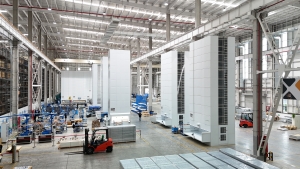
Smart warehouse cabinets (hereafter “smart cabinets”) are automated warehousing equipment that integrate mechanical transmission, automatic control, intelligent sensing, and warehouse management software. Through a “goods-to-person” operating model, they enable high-density storage, automated retrieval, and information-based management of materials. They are one of the core pieces of equipment in modern smart warehousing and in-plant logistics. Their core components include:
-
Mechanical main structure: The foundation for equipment load-bearing and operation, including the cabinet body, frame, guide rails, trays, bins, and pick-and-place actuators, ensuring structural strength and operational stability.
-
Transmission and drive system: Composed of servo motors, reducers, chains, belts, etc., providing power for lifting, rotating, and pick-and-place actions.
-
Intelligent control system: As the core control unit, it uses PLCs, touch screens, and drive modules to execute command parsing, logic control, precise positioning, and safety protection.
-
Warehouse management software system: Centered on WCS/WMS systems, it enables inventory management, order processing, data traceability, report generation, and seamless integration with upper-level systems.
-
Safety protection system: Includes safety door locks, safety light curtains, anti-collision devices, overload protection, emergency stops, and other modules to comprehensively ensure the safety of personnel and equipment.
(II) Operating Principle
Operators issue commands for receiving, shipping, inventory counting, etc., through terminals. After receiving the command, the control system drives the transmission mechanism to automatically deliver the carrier containing the target materials to the access port. After the operator completes the material handling, the system automatically updates inventory data, thereby achieving visualized workflow, traceable material management, and automated retrieval actions.
(III) Main Categories
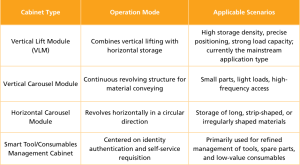
Smart cabinets are divided into vertical lift module (VLM), vertical carousel module, horizontal carousel module, and smart tool/consumables management module, among others.
2025 Smart Warehouse Cabinet Development Review
In 2025, the global smart cabinet industry overall showed a trend of sustained and stable growth. Despite challenges from tariff policy adjustments and global supply chain restructuring, the global market demonstrated strong resilience, driven by robust demand from industries such as e-commerce, semiconductors, and new energy vehicles. In terms of technological innovation, the industry mainly focused on intelligent upgrades and system coordination. While consolidating their position in the domestic market, Chinese smart cabinet companies significantly accelerated their pace of going global.
(I) Market Size
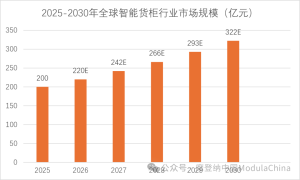
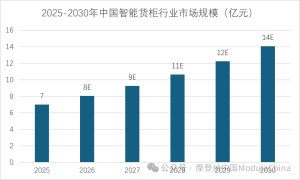
According to reports from research institutions such as Precedence Research and QYResearch, the global smart cabinet market reached approximately RMB 20 billion in 2025. During the same period, mainly driven by favorable macroeconomic policies and downstream demand, the Chinese smart cabinet market reached approximately RMB 700 million.
From a regional structure perspective, Europe and North America accounted for over 70% of the market, with Europe remaining the largest regional market at approximately 45–50%, benefiting from its strong industrial base and sustained demand from the automotive manufacturing industry. The Asia-Pacific region was the fastest-growing market globally, accounting for about 6–7%, mainly benefiting from strong demand in China, Japan, South Korea, and Southeast Asian countries in semiconductors, electronics manufacturing, machinery manufacturing and processing, and e-commerce.
(II) Main Application Industries
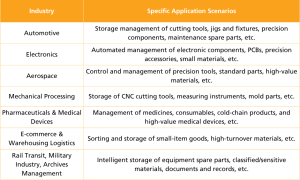
General-purpose (non-refrigerated) smart cabinets dominated the market, with a share of approximately 80%. They are widely used in industries such as automotive, electronics, mechanical processing, pharmaceuticals, aerospace, e-commerce, and warehousing logistics. Notably, customer demand for integrated hardware and software automation is growing. Smart cabinets, with their strong versatility and high flexibility, have been deeply applied across many industries.
(III) Industry Competition Landscape
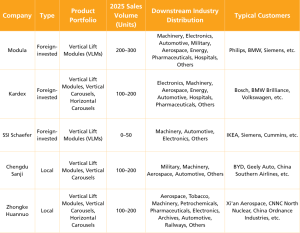
In 2025, the competitive landscape was characterized by “foreign brands leading the high-end segment, with domestic companies catching up and replacing.”
-
High market concentration: The global market is mainly dominated by European and American giants such as Kardex, Modula, and SSI Schaefer, which together account for approximately 50% of the market share.
-
Rapid catch-up by Chinese companies: In the Chinese market, local companies such as Zhongke Huannuo, Chengdu Sanji, and CETC No. 2 Research Institute are rapidly expanding their market share in the mid-to-low-end market and specific industries such as aerospace, leveraging cost-performance advantages and fast delivery response capabilities, showing strong growth momentum.
-
Shifting competitive focus: Price wars are no longer the only means; competition is shifting toward the completeness of solutions. Profit margins from pure hardware sales are narrowing, while integrated solutions combining warehouse management software and warehouse control systems are more profitable and offer stronger overall competitiveness.
(IV) Demand Conditions
In 2025, the domestic market showed diversified yet highly concentrated demand characteristics.
-
Mechanical processing industry: With the continued advancement of the national “smart transformation and digitalization” policy, traditional mechanical processing industries (such as motors, hydraulics, automation equipment, precision machining, and machine tools) have higher requirements for space utilization, access efficiency, safety, informatization, protection, and flexibility. This has driven a significant increase in demand for smart cabinets for storage equipment transformation and upgrading.
-
Electronics industry: Affected by global chip capacity expansion and the precision of electronic components, coupled with high requirements for product quality and safety, the electronics industry saw a surge in demand for smart cabinets with moisture-proof, fire-proof, anti-theft, and anti-static features, making it one of the fastest-growing application segments in 2025.
-
E-commerce and warehousing logistics industry: To improve “goods-to-person” picking efficiency, large logistics centers and e-commerce fulfillment centers began to introduce automated warehousing equipment on a large scale. Vertical cabinets, with advantages such as efficient space utilization, fast picking speed, precise inventory management, strong adaptability, and safety and reliability, have become important tools for improving operational efficiency and reducing costs in the e-commerce and warehousing logistics industry. In 2025, the development of omnichannel retail forced companies to efficiently manage massive SKUs, directly accelerating their procurement of smart cabinets.
(V) Technological Innovation
In 2025, industry technology was no longer limited to simple mechanical structure improvements but moved toward digitalization, collaboration, integration, and high precision.
-
Deep integration of intelligence and software: Products have evolved from single access devices to data nodes. Advanced smart cabinets are not only equipped with warehouse management software but can also integrate systems such as tool management systems, enabling precise “goods-to-person” operations and optimizing work paths through cloud-based data collection systems.
-
Human-machine collaboration and robot integration: A highlight of technological innovation is collaboration with intelligent robots. For example, Modena’s smart cabinets can work with AGVs to achieve automatic transport after “goods-to-person,” forming a fully closed-loop unmanned operation. Standardized interfaces with AGVs/robots have become standard configurations for mainstream products.
-
Optimization of core components: Breakthroughs were achieved in core components and details. For example, Fulipu Precision obtained a patent in September 2025 for “a vertical lift cabinet with a buffer mechanism,” which reduces moving wear through internal buffer components, improving equipment durability and protection performance, demonstrating Chinese companies’ deep cultivation of process details. SSI Schaefer’s smart cabinets use gear transmission technology, ensuring no wear for five years or more and achieving long-term stable and reliable operation.
(VI) Global Expansion
In 2025, Chinese domestic smart cabinet manufacturers actively sought global opportunities, marking the “first year of going global.”
-
Significant supply chain advantages: Facing global supply chain uncertainties, China possesses a complete industrial chain for sheet metal processing, electrical control, and logistics systems, with strong cost control capabilities, giving domestic equipment significant price competitiveness in Southeast Asian, Middle Eastern, Japanese, Korean, and even European markets.
-
Market substitution opportunities: International tariff policies have led to cost increases for some European suppliers, providing Chinese smart cabinet companies with opportunities to enter the market. Despite trade barriers, Chinese companies are mitigating risks by setting up factories in Eastern Europe or Mexico (local production for local sales).
-
Clear target markets: Chinese companies are mainly focusing on emerging markets. Many have made serving the Southeast Asian market one of their strategic priorities, leveraging domestic production capacity to cover the Asia-Pacific region. With its thriving electronics manufacturing and e-commerce market, Southeast Asia has become the preferred testing ground for Chinese smart cabinet companies going global.
2026 Smart Warehouse Cabinet Outlook
Looking ahead to 2026, with the deep integration of AI technology and the growing importance of after-sales service markets, the industry will enter a new stage of high-quality development.
(I) AI Empowers Products and Technologies, Enhancing Flexibility
The technological evolution of smart cabinets will focus on “AI empowerment” and “flexible adaptation.”
-
Deep embedding of AI algorithms to improve operational efficiency: Predictive maintenance based on real-time data analysis will gradually become widespread, enabling early warning of equipment failures. At the same time, AI will optimize storage location allocation algorithms, dynamically adjusting the positions of materials within the cabinet based on access frequency, further improving inbound and outbound efficiency. For example, Modena has launched the new FLEXIBOX product in response to industry needs, with a picking efficiency of up to 180 boxes per hour, helping customers achieve fast and efficient sorting operations.
-
Cloud-edge collaboration and digital twin technology to break operational bottlenecks: Cloud-based warehouse management solutions will be widely adopted, allowing managers to monitor inventory in real time via mobile devices. Combined with digital twin technology, new factories can simulate the operation of smart cabinets in a virtual environment during the construction phase, identifying operational bottlenecks in advance.
-
Customization for extreme scenarios to build technological barriers: In addition to standard models, more specialized smart cabinets will emerge for high-precision large parts in aerospace and deep-cold environments in cold-chain logistics, such as ultra-heavy cabinets with a load capacity exceeding 100 tons or pharmaceutical-dedicated cabinets with temperature control accuracy of ±0.5°C.
(II) Deepening Niche Markets, High Demand for Customization
The market will become more segmented, and deep cultivation in vertical domains will be key to success.
-
Surge in demand from emerging industries: In addition to automotive and semiconductors, the medical and health industry will become a new growth pole. With stringent traceability requirements for innovative drugs and medical devices, demand for smart cabinets with high cleanliness, high safety, and constant temperature and humidity will increase significantly.
-
Rise of after-sales service market demand: As the installed base grows year by year, services for retrofitting, relocation, and upgrading of old cabinets will become new profit points. In the future, more manufacturers will introduce “trade-in” or “control system upgrade package” services to help customers connect traditional smart cabinets to the Industrial Internet.
-
Further channel (market penetration): With the implementation of the “15th Five-Year Plan,” industrial transfer to the central and western regions will drive local manufacturing automation transformation and upgrading, and regional market demand growth will outpace that of traditional coastal industrial zones.
(III) A Comprehensive After-Sales Service System Will Become a Key Competitive Edge
After-sales service will transform from a “cost center” to a “value center.”
-
Full-lifecycle services: In response to cost management needs of small and medium-sized customers, some companies are piloting subscription-based service models. Instead of one-time equipment purchases, customers pay an annual fee covering hardware usage, software updates, and maintenance services. This model effectively lowers the barrier to smart transformation for SMEs.
-
Localized “rapid response mechanisms”: For companies going global, the core competition in 2026 lies in overseas service delivery capabilities. Pure equipment exports are no longer sustainable; companies need to establish overseas spare parts warehouses and localized technical service teams. Companies that can respond to overseas customer needs within 24 hours will have a decisive competitive advantage.
-
Training and knowledge transfer: To address high operator turnover, more comprehensive VR/AR training methods and remote training systems will be provided. Operators can use wearable devices to simulate troubleshooting exercises, reducing downtime caused by misoperation, while also building a smart cabinet operation and maintenance knowledge base.