



Warehouse space is becoming increasingly tight, prompting managers to consider relocating to larger, more expensive warehouses to accommodate expanding operational needs.
However, despite rising warehouse costs, there are still efficient ways to increase operational efficiency within your existing space.
We’ll cover Vertical Lift Modules (VLMs), their advantages, and how they outperform Vertical Carousels (VC).
We’ll also show how our vertical lift modules can revolutionize your warehouse operations and significantly increase profitability.
What is a Vertical Lift Module (VLM)?
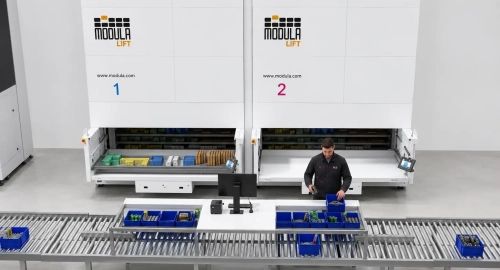
The Vertical Lift Module (VLM) is an automated storage and retrieval system (ASRS) that operates on the “goods-to-person” principle.
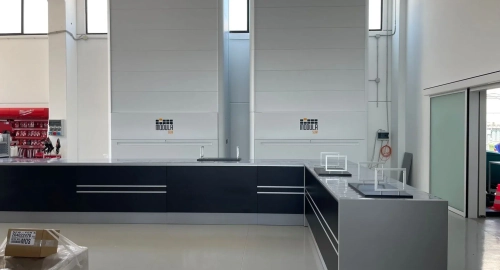
VLM maximizes storage through efficient use of ceiling height and is ideal for facilities with smaller spaces.
Vertical Carousel (VC) vs. Vertical Lift Module (VLM): Which is better?
First, vertical lift modules (VLM) are superior to vertical rotating racks (VC) in terms of higher efficiency, better space utilization, and safety of stored items.
Here’s how they compare:
definition
Vertical Carousels (VC) are equipped with a series of storage boxes fixed on a chain drive. The motor rotates these carrier boxes vertically along the track, and can run in both forward and reverse directions, somewhat similar to the movement of a Ferris wheel.
In contrast, a Vertical Lift Module (VLM) is a storage system consisting of two rows of pallets and a vertically moving central lift that automatically accesses and delivers pallets to warehouse operators.
width and depth
The two technologies don’t differ much in terms of width, so it’s not the main differentiating factor. However, the vertical lift module is approximately twice as deep as the vertical rotating rack, giving the VLM a smaller footprint.
But you also need to pay attention to ergonomics. Pallets should not be too deep so that warehouse operators can easily reach items without strain.
Vertical lift modules are typically 5 to 15 feet wide and 7 to 10 feet deep. Their storage trays range from 4 feet to over 13 feet wide, with depths of 2 to 3 feet, and a maximum storage item height of 28+ inches.
In comparison, vertical rotating racks are typically between 6 and 13 feet wide and 4 to 5+ feet deep for smaller items. Their cargo boxes range from 4 feet to nearly 12 feet in width, 16 to 24 inches in depth, and store items up to 18.5 inches in height.
Balancing requirements
Vertical rotating racks need to be carefully balanced to avoid uneven weight distribution between pallets.
The vertical lift module does not require a balancing pallet. Its design eliminates the risk of overloading individual pallets, thereby enhancing the overall stability and safety of the system.
Accessibility:
Vertical rotating racks require moving the entire set of racks to access items, which can impact productivity and efficiency.
Vertical lift modules, in contrast, feature automated systems that quickly locate and retrieve needed items without having to move the entire structure. This significantly reduces pickup time and increases productivity.
Install
Vertical rotating racks use one-piece end frames, which are less flexible and more challenging to install. Due to the heavy structure, installation usually takes up to four days to complete.
The VLM’s modular components make it easier to transport and assemble – typically in just two days.
This efficient installation process minimizes downtime and enables flexible configurations in a variety of spaces, speeding operational integration.
How does the Vertical Lift Module (VLM) work?
The vertical lift module uses a variety of mechanisms to automatically deliver inventory to warehouse operators:
1. When warehouse employees need an item, they simply enter the SKU information into the computer interface. After VLM’s control system is integrated with the warehouse management system (WMS), it will automatically calculate the optimal pickup route.
2. The pick-and-place device (inserter/extractor) will move to the designated pallet, pick up the pallet and send it to the operation port or picking table for employees to pick up items.
3. More advanced VLMs are also equipped with multiple access points, allowing multiple employees to pick up goods at the same time, further reducing waiting time.
4. The module will then return the pallet to its original position.
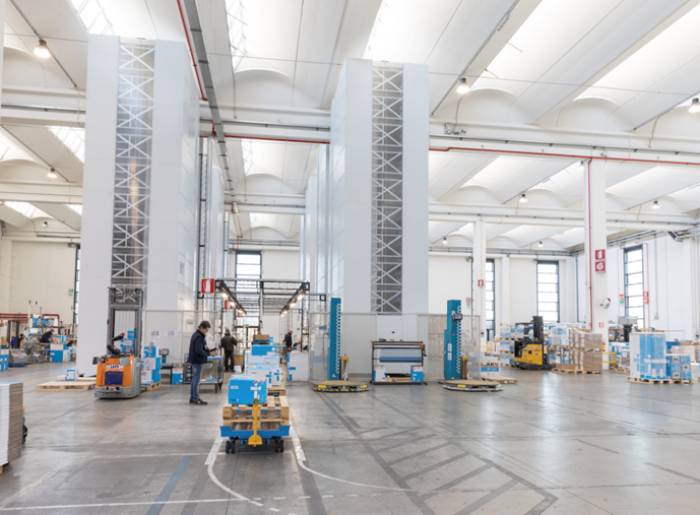
Vertical Lift Module (VLM) Options and Accessories
The versatility of VLM allows it to be easily integrated with other technologies, further realizing its potential.
Key technologies include:
Enhanced vision technology: The technology guides operators to locate pickup locations, quantities, and confirm items;
Autonomous Mobile Robots (AMRs): AMR can transport items or pallets to the next work station or to VLM to complete the order;
Integrated robotics: Robotic arms prevent human error in the picking process;
Warehouse Management System (WMS): Can track inventory levels, manage orders, and oversee the picking process in the warehouse;
Light picking system (Pick-to-Light): While improving production efficiency, the accuracy rate can exceed 99.9%;
Constant temperature environment module;
Clean room applications;
Conveyors, scales, scanners, label printers, barcode readers, RFID, pallet accessories and other innovative devices.
Five reasons to adopt Vertical Lift Modules (VLM) for your modern warehouse
Here’s how these advanced systems can transform your storage and retrieval processes:
1. Increase storage density
Vertical lift modules optimize space through vertical storage, significantly increasing storage capacity without expanding the warehouse area.
At Modula APAC, our modular pallets are designed to carry heavy loads with ease.
2. Improve picking speed
VLM saves a lot of time when picking because you only have to wait for the pallet containing the required items to be called out, rather than waiting for the entire group of pallets. Operators can pick items faster and more accurately with the help of a variety of visualization tools, including laser pointers.
Our VLM achieves picking efficiencies of over 300 lines per hour.
3. Ensure inventory security
The vertical lift module protects inventory through a closed design and is accessible only to authorized personnel. Security features include: controlled access points, user authentication, electrostatic discharge (ESD) protection, automatic doors.
These measures reduce the risk of theft and damage and ensure that valuables are well protected.
4. Improve employee safety
A recent study found a direct link between fatigue at work and injuries.
Warehouse operators who frequently bend or reach to retrieve goods are at higher risk of injury.
The vertical lift module automates the storage and retrieval process, reducing the need for employees to perform potentially hazardous operations such as climbing or lifting heavy objects.
5. Reduce labor costs
Automation reduces the labor costs required for storage and retrieval.
For example, instead of multiple employees manually finding and moving items, it is better to let the VLM system complete this task efficiently, with only one operator controlling it from a central control station.
6. Achieve rapid return on investment (ROI)
VLM often brings significant cost savings through efficiency improvements, labor savings and safety assurance. Companies can recoup their initial investment by streamlining operations and reducing overhead.
Integrating Modula VLM into your warehouse operations typically results in a return on investment of 6 to 18 months.
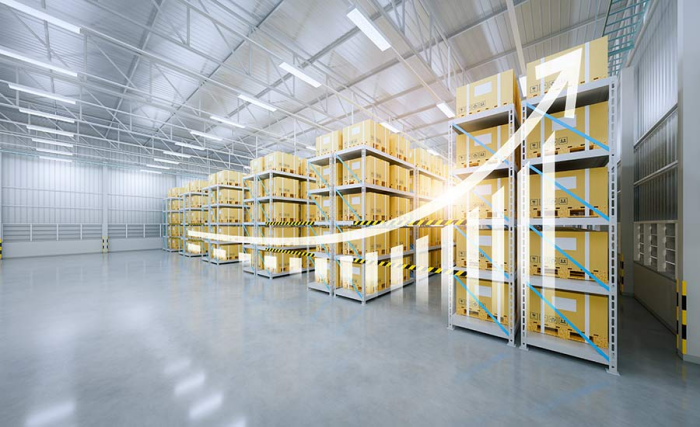
Explore advanced vertical lift modules (VLM) at Modula APAC
At Modula APAC, we recommend upgrading from vertical rotating racks to more efficient and adaptable vertical lift modules.
VLM provides a more space-saving storage solution for your warehouse by utilizing ceiling height.
Our equipment gives warehouse operators easy access to large inventories, with all items stored in secure modules. Simply touch the screen or scan a barcode via the intuitive Copilot controller, and items are automatically delivered to the operating port.
The VLM products we offer include:
Modula Lift: Modula Lift can recycle up to 90% of the warehouse floor space, increase work efficiency by 2 to 3 times, and the picking accuracy is close to 100%;
Modula NEXT: Modula NEXT is equipped with a uniquely designed opening that only opens for specific compartments when picking, eliminating picking errors or item loss and ensuring your warehouse operates efficiently;
Modula Slim: Modula Slim is ideal for storing bulk materials and small components such as containers (cases, boxes, cartons and pallets), bottles and rolls.
It’s time to say goodbye to vertical rotating shelves.
A brief review of vertical lift modules (VLM) in modern warehousing
If you are considering an automated storage and retrieval system, it is crucial to determine which system is best for your material handling processes.
To sum up, the vertical lifting module is better than the vertical rotating shelf in terms of picking accuracy, safety and speed.
VLM has no restrictions on depth, height and product variety, providing greater flexibility and capabilities while improving ergonomic design.
At Modula APAC, we can help you re-evaluate your warehousing solutions with the help of our advanced vertical lifts.
Modules increase productivity, ensure picking accuracy, and keep employees safe so your operations continue to run efficiently.
![Unlocking Efficiency With Vertical Lift Modules [Benefits & FAQs]](https://en.modula.cn/wp-content/uploads/2025/06/vertical-lift-modules-hero-image-500x270-c-center.webp "Unlocking Efficiency With Vertical Lift Modules [Benefits & FAQs]")