







Inventory Management With Modula: Key Takeaways
- Inventory management delivers measurable gains like faster fulfilment, fewer stock issues, and higher customer satisfaction
- Inventory management techniques include demand planning, LIFO, FIFO, and just-in-time inventory
- Modula’s warehouse management system (WMS) is the smart hub of your warehouse, managing stock control, location tracking, operator activity, and picking accuracy in a centralised platform
A recent study found that 24% of consumers say they couldn’t buy what they wanted simply because it was out of stock.
This shows us exactly why effective inventory management matters, as it keeps products available, sales flowing, and customers happy.
In this guide, we will:
- Highlight the business impact of effective inventory management
- Explore 15 proven inventory management techniques
- Cover emerging trends shaping the future of inventory management
- Share how you can optimise your inventory management with Modula’s software solutions
Benefits of Inventory Management
Effective e-commerce inventory management delivers measurable gains, including:
Enhanced Efficiency
Reliable inventory management helps avoid excess stock, cuts down on storage costs, and keeps operations running smoothly by spotting and fixing workflow bottlenecks.
Implement strategies like just-in-time (JIT) delivery and first in, first out (FIFO) to keep inventory turnover high and reduce waste.
Improved Financial Accuracy
Accurate inventory data strengthens forecasting and purchasing decisions.
It enables businesses to respond quickly to demand trends and avoid overstocking or stockouts, both of which can hurt profitability.
Reduce Risk
Smart inventory planning helps shield your business from common supply chain disruptions, such as:
- Delayed shipments
- Sudden demand spikes
- Raw material shortages
- Unexpected supplier setbacks
With the right stock management system in place, you can monitor stock levels and sales trends in real time, allowing you to reorder before items run out.
Reinforced Customer Loyalty
Managing your inventory helps you meet orders quickly and keep high-demand items available, factors that keep loyal customers coming back for more.
When you use insights from inventory analytics, you can fine-tune your purchasing schedule to ensure best-sellers are always on hand.
Prevents Spoilage
For businesses that sell perishable goods, timing is everything. If a product with an expiration date doesn’t sell quickly, it’s likely to go to waste.
Research from the Pacific Coast Food Waste Commitment (PCFWC) shows that adopting specific inventory and e-commerce strategies can significantly reduce spoilage and food waste:
- Offer produce in varied conditions: Letting customers choose ripeness or opt for “imperfect” items, especially with educational messaging, boosts sales and reduces spoilage
- Limit handling to extend shelf life: Storing perishables in back-of-house for e-commerce reduces touchpoints, preserving quality and cutting waste
Effective stock management helps you stay ahead by tracking shelf life, rotating stock efficiently, and ensuring products are sold before they spoil.
Avoid Dead Stock
Dead stock ties up valuable space and capital, not because it’s expired, but because it’s outdated, out of season, or simply no longer in demand.
With a proactive inventory strategy, you can:
- Spot slow-moving items early
- Adjust your purchasing or promotions before products become unsellable
- Reallocate or bundle stagnant stock to recover costs and clear shelf space
On the flip side, keeping a close eye on stock levels also helps prevent overselling or relying on phantom inventory, also known as items that appear available in your stock management system but are actually out of stock.

15 Inventory Management Techniques
Whether you’re running a small shop or a large operation, using proven inventory management techniques can help you stay on top of your stock, cut costs, and boost efficiency.
- Economic order quantity (EOQ): Calculates the ideal order size to minimise holding and ordering costs.
- Demand planning: Forecasts future customer demand to ensure accurate inventory levels.
- Inventory counts: The process of physically counting stock to match records and identify discrepancies.
- LIFO vs FIFO: Determines whether the most recent (LIFO) or oldest (FIFO) inventory is sold first.
- RFID technology: Uses radio-frequency tags to automatically track inventory in real time.
- Barcode: Provides a quick and accurate way to scan and manage inventory.
- ABC reporting: Classifies inventory into A, B, and C groups based on value and importance.
- Inventory valuations: Assigns a financial value to inventory for accurate reporting and analysis.
- Minimum order quantities: Sets the smallest amount a supplier will sell in a single order.
- Safety stock alerts: Triggers notifications when inventory levels hit a low threshold.
- Inventory audits: Performs regular checks to verify that physical stock matches system data.
- Dropshipping: Ships products directly from the supplier to the customer, bypassing in-house inventory.
- Supplier relationships: Building strong vendor partnerships ensures better pricing and reliability.
- Outsource stock management: Delegates stock control to third-party providers to save time and cost.
- Just-in-time (JIT): Decreases inventory levels by receiving goods only when they’re needed for production or sale.
Top Inventory Management Trends
The latest technologies aren’t just trends, they’re reshaping how we manage inventory.
Here’s how modern tools are changing the game.
Predictive Analytics
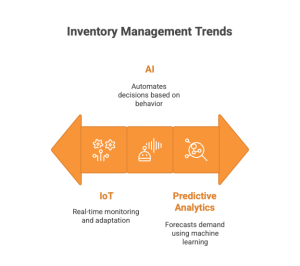
Predictive analytics combines automation, data, and machine learning to forecast demand and maximise inventory.
As the system ingests more data over time, such as seasonal trends, sales velocity, and customer behaviour, it delivers increasingly accurate insights that drive smarter, faster inventory decisions.
Artificial Intelligence
Artificial intelligence is becoming more integrated into inventory management, offering real-time automation and smarter decision-making.
According to Statista, AI is used to predict consumer behaviour, insights that help businesses:
- Anticipate demand more accurately
- Align inventory levels with buying patterns
- Ensure popular products are always in stock when customers are ready to purchase.
With self-correcting capabilities, AI can adjust to changing demand patterns, helping businesses respond faster to customer needs, reduce excess stock, and improve overall efficiency.
Internet of Things (IoT)
The Internet of Things (IoT) is reshaping e-commerce by powering smarter inventory management, faster order fulfilment, and more personalised shopping experiences.
Real-world examples include Amazon’s delivery drones, as well as smart vending machines that monitor stock levels and adapt to customer preferences.
Optimise Inventory Management With Modula’s Warehouse Management System (WMS)
Modula WMS acts as the digital command centre of your warehouse, bringing together stock control, location tracking, operator performance, and picking accuracy in one intelligent, real-time platform.
Seamlessly integrating with your existing ERP, DMS, or IoT systems, Modula ensures smooth operations and consistent, reliable data across your entire workflow.
Experience the benefits of Modula WMS, including:
- Real-time visibility: Monitor stock levels, expiry dates, and SKU movement with precision. Custom dashboards and live reports help reduce stockouts and overstocking, keeping inventory lean and optimised.
- Seamless ERP integration: Break down silos with full ERP and DMS compatibility. Maintain synchronised workflows, end-to-end traceability, and accurate order fulfilment.
- Error-proof operations: Automated picking strategies and barcode verification minimise human error and elevate picking accuracy to industry-leading standards.
- Scalable and modular: From single sites to complex warehouse networks, Modula WMS supports VLMs, AMRs, AGVs, and advanced storage systems—scaling as your business grows.
- Compliance and reporting: Built-in traceability tools, audit trails, and custom reports support industry and regulatory compliance, especially in high-stakes sectors.